
What is Industrial Automation?
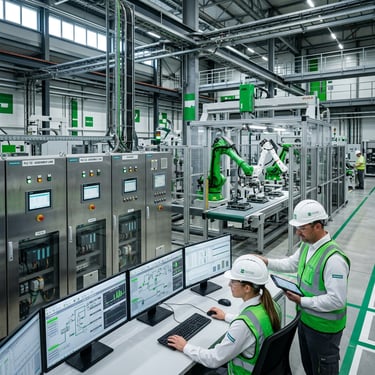
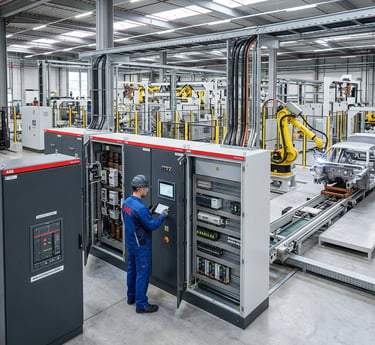
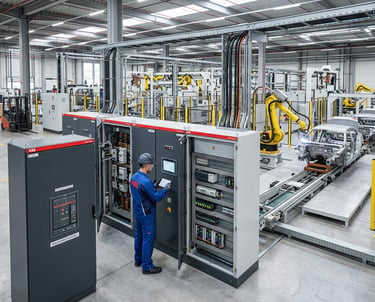
Industrial automation is the use of advanced technologies such as PLCs, SCADA systems, sensors, robotics, VFDs, and control systems to automate industrial processes and machinery with minimal human intervention.
INDUSTRIAL AUTOMATION
5/8/20242 min read
Introduction
Industrial automation is the use of advanced technologies such as PLCs, SCADA systems, sensors, robotics, VFDs, and control systems to automate industrial processes and machinery with minimal human intervention.
Automation helps industries improve:
Productivity
Accuracy
Safety
Energy efficiency
Operational reliability
Today, industrial automation plays a major role in manufacturing plants, pharmaceutical industries, food processing units, automotive factories, textile plants, and smart factories worldwide.
Why Industrial Automation is Important?
Modern industries face challenges such as:
High labor costs
Human errors
Production delays
Machine downtime
Energy wastage
Industrial automation solves these problems by enabling machines and systems to operate automatically and intelligently.
Main Components of Industrial Automation
1. PLC (Programmable Logic Controller)
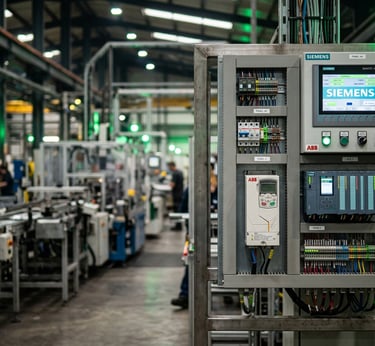
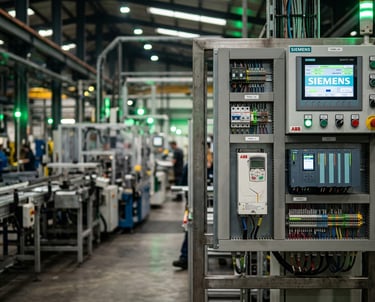
A PLC is an industrial computer used to control machines and processes.
Functions of PLC:
Machine control
Process automation
Sensor monitoring
Motor operation
Data handling
PLCs are widely used because they are reliable, durable, and suitable for industrial environments.
Popular PLC brands:
Siemens
Allen Bradley
Mitsubishi
Schneider Electric
2. SCADA System
SCADA (Supervisory Control and Data Acquisition) systems help industries monitor and control processes in real time.
SCADA Features:
Live data monitoring
Alarm management
Historical data analysis
Remote operation
Process visualization
SCADA systems improve operational efficiency and help engineers quickly identify issues.
3. VFD (Variable Frequency Drive)
A VFD controls the speed and torque of electric motors.
Advantages of VFD:
Energy saving
Smooth motor operation
Reduced mechanical stress
Longer motor life
Better process control
4. Sensors and Instruments
Sensors collect data from machines and industrial processes.
Common Industrial Sensors:
Temperature sensors
Pressure sensors
Proximity sensors
Flow sensors
Level sensors
These sensors help automation systems make intelligent decisions.
Benefits of Industrial Automation
Increased Productivity - Automation systems can operate continuously with high efficiency.
Improved Quality - Automated systems reduce human errors and maintain consistent product quality.
Better Safety - Hazardous tasks can be handled by machines instead of workers.
Reduced Downtime - Real-time monitoring helps prevent machine failures.
Energy Efficiency - Smart systems optimize energy consumption.
Future of Industrial Automation
The future of industrial automation includes:
Artificial Intelligence (AI)
Industrial IoT (IIoT)
Smart factories
Predictive maintenance
Cloud-based monitoring
Robotics integration
Industries are rapidly moving toward Industry 4.0 technologies to improve competitiveness and efficiency.
Why Choose Gatilek for Industrial Automation Solutions
At Gatilek, we provide:
PLC Programming
SCADA Development
Siemens Automation Solutions
VFD Integration
Industrial Control Panels
Automation Consultancy
Our goal is to help industries improve productivity, reduce downtime, and achieve smarter operations through reliable automation solutions.
Conclusion
Industrial automation is transforming industries by improving efficiency, accuracy, safety, and productivity. Technologies like PLCs, SCADA systems, VFDs, and smart sensors are helping businesses move toward smarter and more reliable manufacturing processes.
As industries continue to adopt advanced automation technologies, companies that invest in automation today will gain a strong competitive advantage in the future.
© 2026 Gatilek Private Limited All Rights Reserved.


Delivering reliable industrial automation, electrical control panels, PLC-SCADA solutions, VFD systems, and power distribution solutions that help industries improve productivity, efficiency, and operational safety.
Maharashtra, India.
608, 6th Floor, Town Centre II,
Andheri Kurla Road, Marol,
Andheri East, Mumbai - 400059
+91 70212 38903
marketing@gatilek.co.in
Follow Us On
Vasai | Bharuch | Nashik | Pune